Every professional drone job should start with a risk assessment. It doesn't need to be long. It needs to list what could go wrong at this site, how likely and how bad each one is, and what you'll do about it. A risk matrix is the simplest way to do that consistently.
How the matrix works
Each hazard gets two ratings:
- Likelihood: how likely is it to happen? From rare to almost certain.
- Consequence: if it happens, how bad is it? From insignificant to catastrophic.
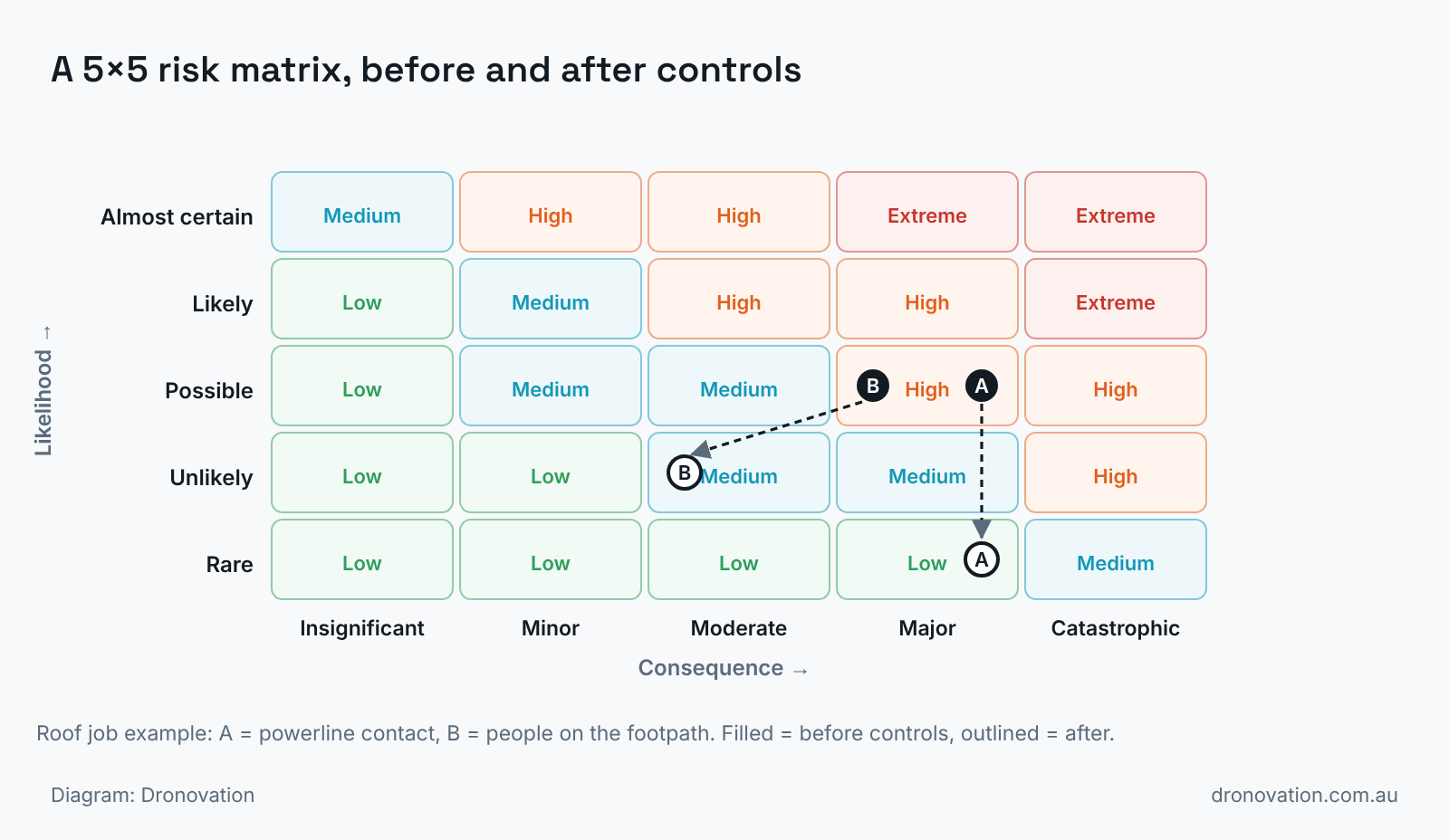
Combine them on a grid, often five by five, to get a risk level: low, medium, high or extreme. Your procedures say what each level means. For example: low can proceed, medium needs controls, high needs a senior decision, extreme doesn't fly.
Step by step
- List the hazards for this job: people, property, aircraft, airspace, weather, equipment, the pilot.
- Rate each one before controls: likelihood and consequence.
- Choose controls that reduce likelihood, consequence or both.
- Rate it again with the controls in place. That's the residual risk.
- Decide: is the residual risk acceptable under your procedures? If not, change the plan or don't fly.
- Brief the team and keep the assessment with the job records.
Choosing controls that work
Not all controls are equal. In order of strength:
- Eliminate: change the plan so the hazard isn't there. Fly early, before people arrive.
- Separate: keep the hazard and the drone apart. A cordon, a different flight path, more height over a road.
- Engineer: use technology. Geofences, obstacle sensing, a parachute system.
- Procedures: checklists, observers, a briefing, a wind limit.
- Protection: hard hats for the crew, signage for the public.
Stronger controls are worth more. "The pilot will be careful" isn't a control.
A worked example: a roof inspection in the suburbs
A two-storey house, footpath out the front, neighbours either side, a powerline along the street.
- People on the footpath under the flight path. Before: possible, major. With controls (fly the rear and sides first, an observer at the front, pause when people pass, no flights over the footpath): unlikely, moderate.
- Contact with the powerline. Before: possible, major. With controls (daytime site check, flight path away from the line, return-to-home height set above the line, no flights between the house and the line): rare, major.
- Loss of link behind the house. Before: possible, moderate. With controls (keep visual line of sight, failsafe set to hover then return, launch from the side with clear view): unlikely, minor.
- Neighbours' privacy. Before: likely, minor. With controls (letterbox notice, camera on the roof only, crop images): unlikely, minor.
With those controls, every residual risk is low or medium, so the job can go ahead as planned.
Common mistakes
- Copying last month's assessment without visiting the site
- Listing controls nobody actually does
- Rating everything medium
- Not re-assessing when conditions change on the day
Beyond the matrix
A matrix suits routine work. More complex operations, such as beyond visual line of sight or flying close to people, need a more structured assessment of air and ground risk, which CASA reviews as part of the approval.
General information only. Use the risk method in your own operations manual, and check CASA's current requirements.