Drones and aircraft share the same low airspace near airports, which is why the rules there are strict. Here's what applies and how professional operators get permission to fly closer.
Controlled aerodromes: the 5.5 km rule
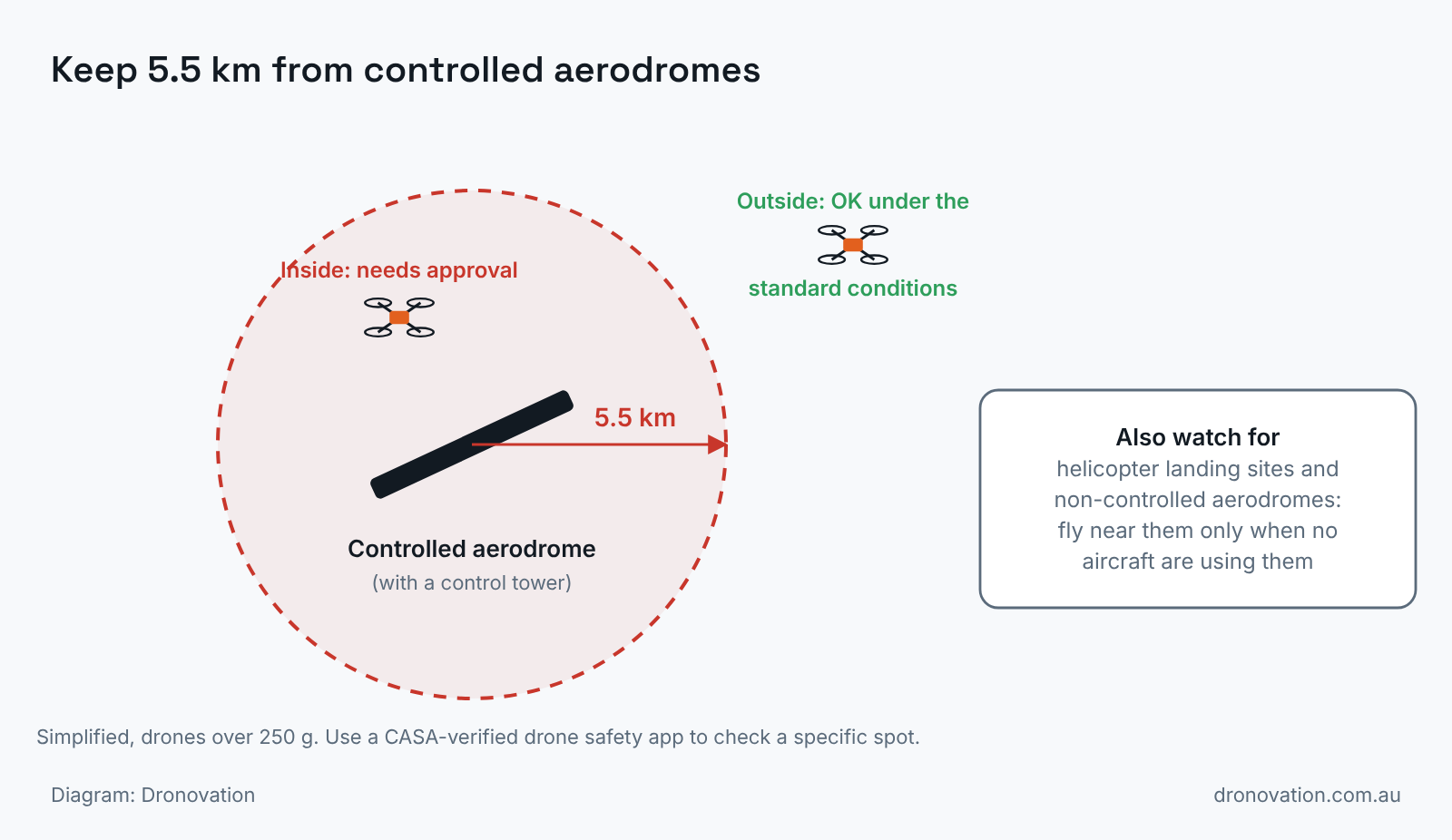
Under the standard rules, a drone over 250 g must not fly within 5.5 km of a controlled aerodrome, meaning an airport with a control tower. That includes the major capital city airports and many regional ones.
Micro drones (250 g or less) have some extra flexibility, but must still stay out of the approach and departure paths and away from the movement area.
Non-controlled aerodromes and helicopter landing sites
Near airfields without a tower, and near helicopter landing sites such as hospital helipads, you can fly within 5.5 km if you:
- stay out of the approach and departure paths
- stay out of the airfield's movement area
- land as soon as safely possible if you see a crewed aircraft or helicopter nearby
Why the rules are strict
Aircraft near airports are low, slow and committed to their flight path, and pilots can rarely see a drone in time. Helicopters often operate below 150 m and can appear with little warning. Even a small drone can do serious damage to a rotor or engine.
How commercial operators fly closer
Some jobs need to happen near airports: roof inspections in suburbs under the flight path, construction surveys, infrastructure work. Operators with a ReOC can:
- apply for an airspace authorisation to fly in controlled airspace, sometimes through automated systems for low-risk areas
- work with air traffic control under agreed procedures, often with a radio-qualified pilot (AROC)
- plan with height limits that keep the drone well below any aircraft
These authorisations are specific to the operator, the place and the time. A permission one company has doesn't cover anyone else.
How to check
A CASA-verified drone safety app shows controlled airspace and nearby aerodromes, including helicopter landing sites. Check it before every flight, not just the first time you fly in an area.
General information only. See CASA's drone safety rules for the current requirements.