A remotely piloted aircraft operator's certificate (ReOC) is CASA's certificate for organisations that run drone operations beyond the simplest category. Some businesses need one; many don't. Here's how to decide.
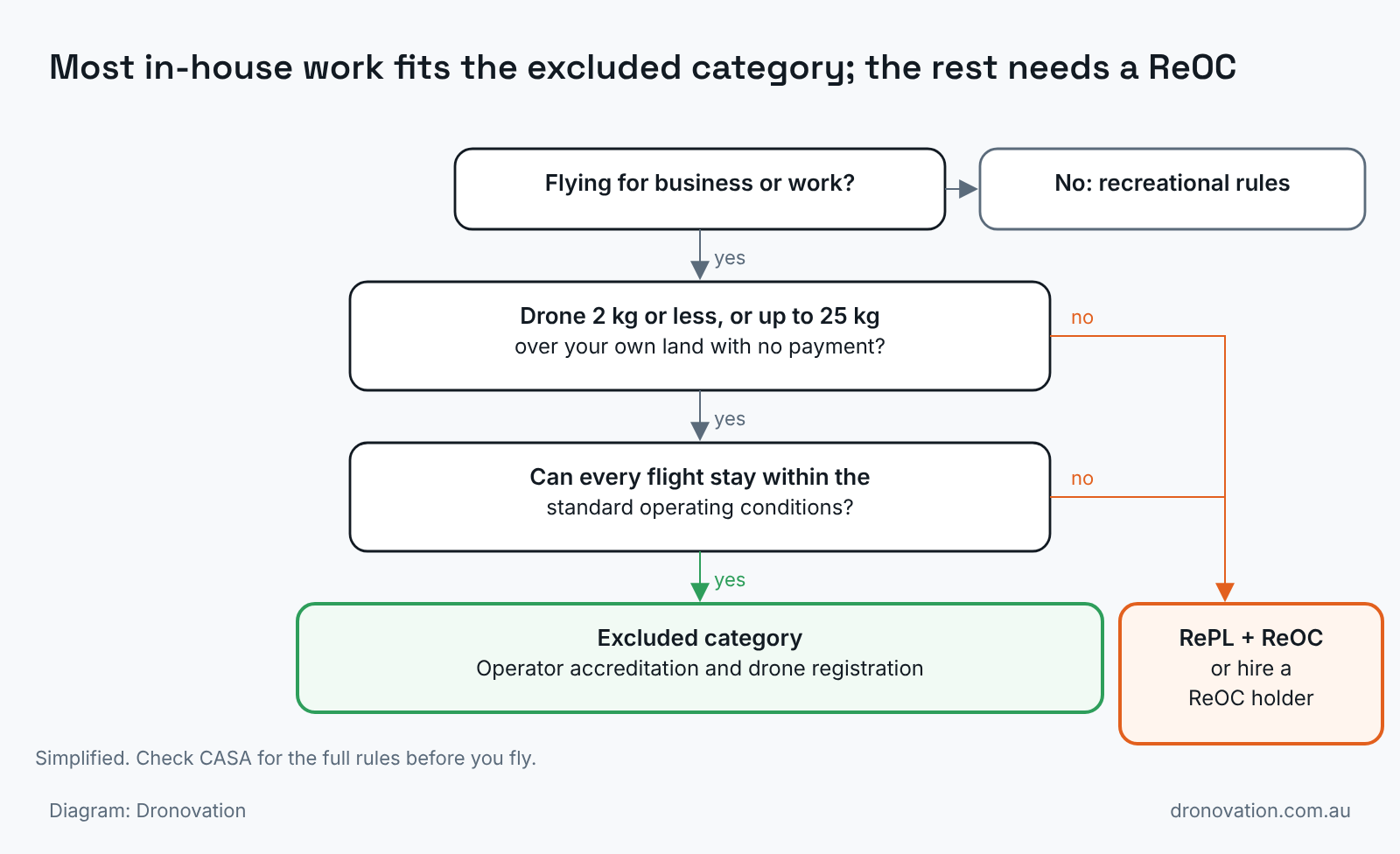
You probably don't need a ReOC if
- your drones weigh 2 kg or less, and
- you fly only within the standard operating conditions: by day, within sight, at or below 120 m, at least 30 m from people, not near controlled aerodromes, and
- the flights are for your own business, such as a builder filming progress or an agent photographing a listing
That's the excluded category. Each pilot needs operator accreditation, each drone must be registered, and the rules must be followed every time.
You probably need a ReOC if
- you want to fly for clients as a drone service business, with drones over 2 kg
- you need to work outside the standard operating conditions: at night, closer to people, beyond visual line of sight, or in controlled airspace near aerodromes
- you want to train remote pilots for their licence
What holding a ReOC involves
A ReOC isn't just a certificate on the wall. To get and keep one, an organisation needs:
- A chief remote pilot, accountable to CASA for how operations are run
- An operations manual and procedures covering planning, risk assessment, emergencies, maintenance and training
- Licensed pilots: every remote pilot holds a RePL for the drones they fly
- Records: operational releases, flight logs, pilot logs, maintenance logs and training records, some kept for seven years
- Approvals for anything outside the standard rules, applied for separately
Options if you don't want your own
- Hire a ReOC holder. For occasional complex jobs, it's usually cheaper than running your own program.
- Stay in the excluded category and design your work to fit the standard rules.
- Start in the excluded category and grow. Build good records and habits early, and the step up to a ReOC is much easier.
Questions to ask before you apply
- How many flights a month will need it?
- Who will be chief remote pilot, and do they have the time?
- How will you keep records? Spreadsheets work at first but break as the team grows.
- Which approvals will you need in the first year?
General information only, not legal advice. CASA's drone safety rules page is the place to start. Dronovation holds CASA.ReOC.8357.