Getting a computer vision model to find defects in a notebook takes days. Getting it to work reliably on real data, every day, for paying clients takes much longer. Here's what changes between prototype and production.
The prototype
- A few hundred labelled images
- A model trained in a notebook
- Impressive results on a test set from the same data
What production needs
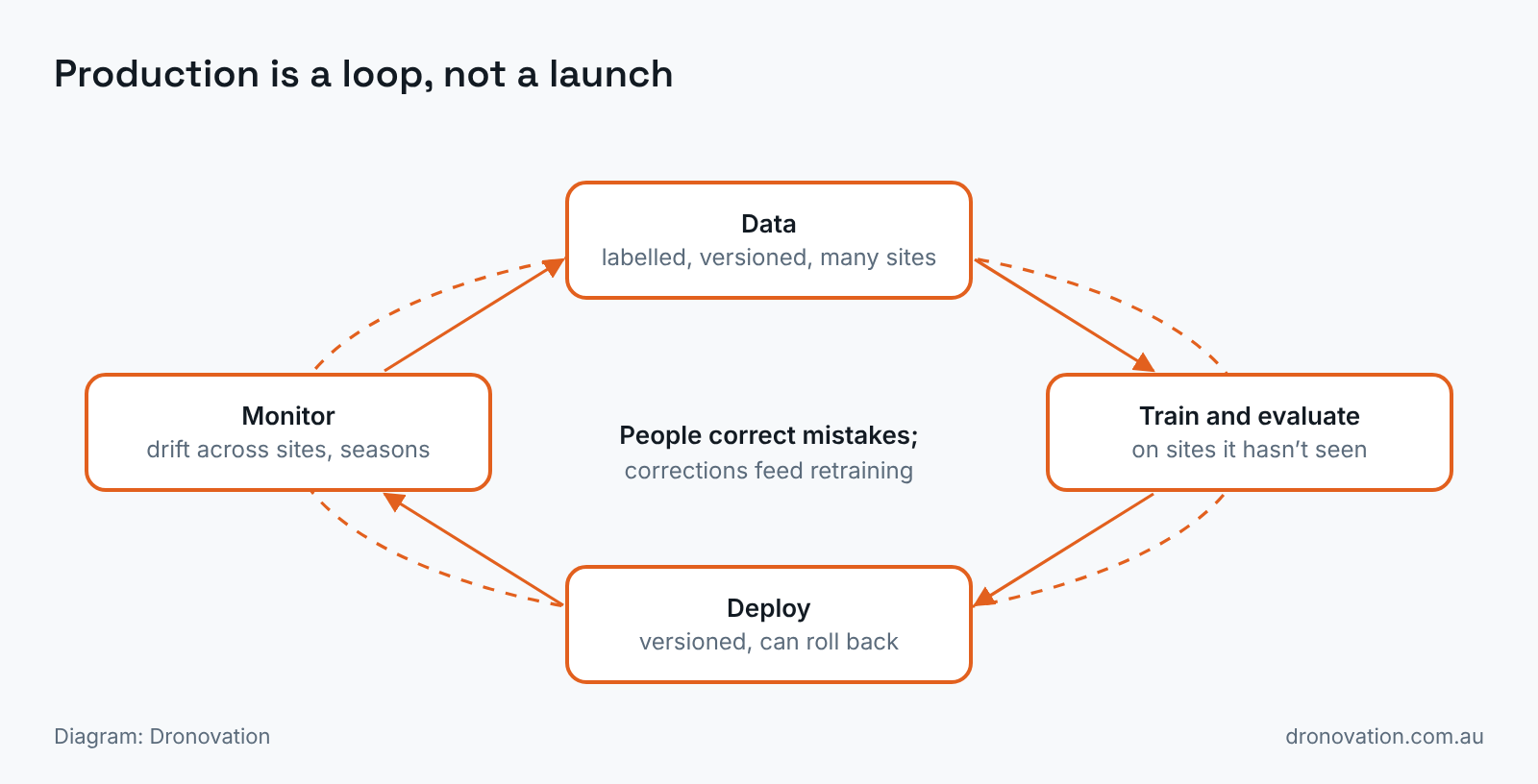
Data
- Labelled data from many sites, cameras and conditions
- A labelling process with clear rules and quality checks
- Versioned datasets, so you know which data trained which model
Training and evaluation
- Repeatable training pipelines (for example in Azure Machine Learning)
- Evaluation on data the model hasn't seen, from new sites
- Metrics that match the business: missed defects cost more than false alarms, or the other way round
Deployment
- A way to run the model where it's needed: in the cloud on uploaded images, or on a device
- Versioned models, with the ability to roll back
- Processing that scales from one flight to hundreds
Monitoring
- Tracking performance on live data, not just at launch
- Watching for drift when cameras, sites or seasons change
- A loop where people correct the model's mistakes and those corrections feed retraining
Trust
- Every prediction linked to its image
- People confirming findings before they reach a client
- Clear records of model versions used in each report
The usual lesson
The model is often less than a third of the work. Data, pipelines, monitoring and the user experience around review make up the rest, and decide whether the system is trusted.
We build these systems for our own products, and can build them for organisations that need computer vision in their own workflows.