Whether you fly for fun or for work, the same core rules apply to most drone flights in Australia. CASA calls them the drone safety rules, or the standard operating conditions when you fly for business. Here they are in plain English.
The core rules
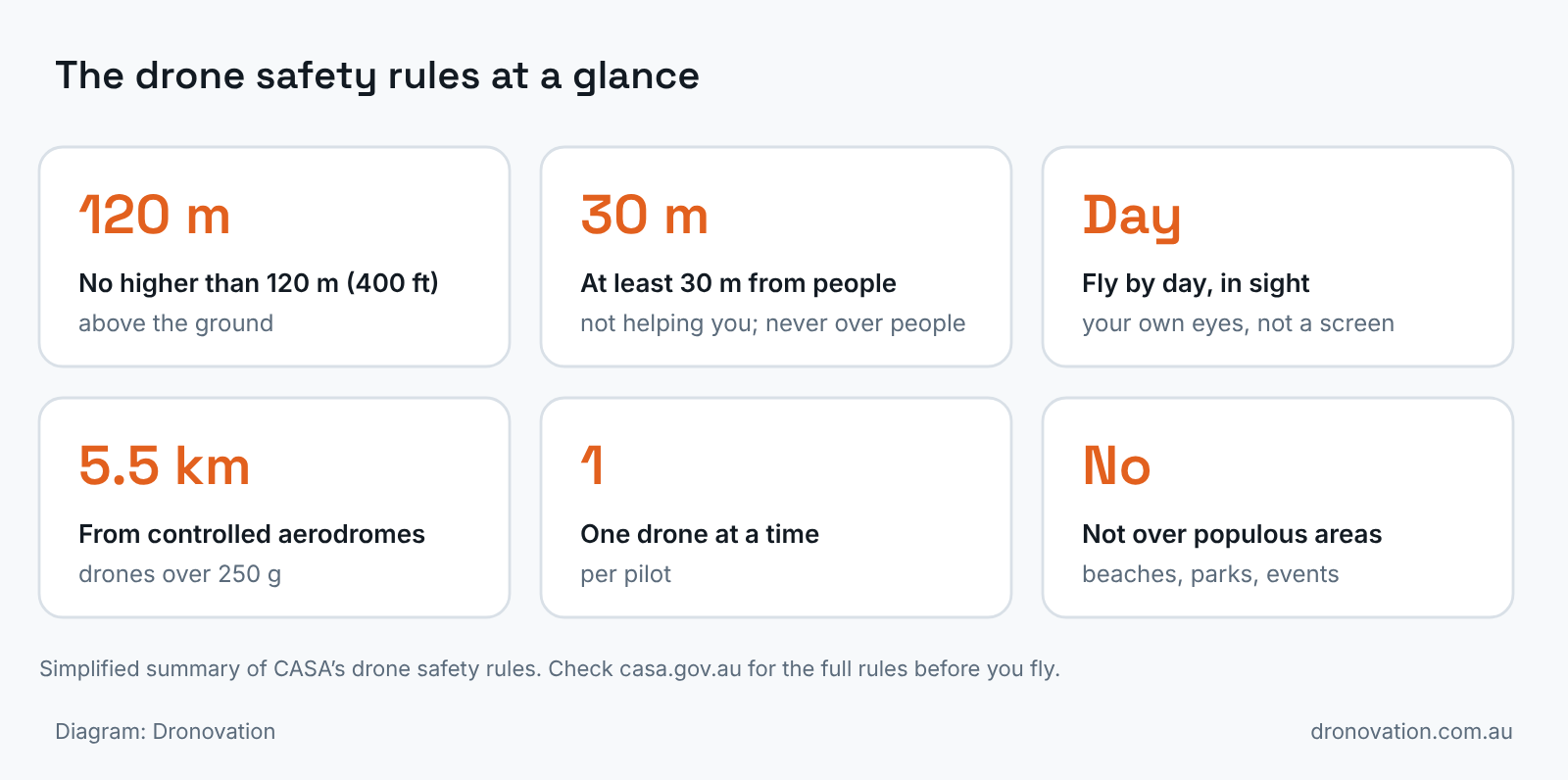
- Stay at or below 120 m. That's about 400 ft above the ground, roughly a 30-storey building.
- Keep it in sight. You must be able to see the drone with your own eyes at all times, not only on a screen or through goggles.
- Day only. No flying at night unless you hold the right approvals.
- Keep 30 m from people. Anyone not helping you fly needs a 30 m buffer.
- Never over people. Not over crowds, beaches, sports grounds, parades or concerts, at any height.
- One drone at a time.
- Not near emergencies. Stay away from fires, crashes, police operations and search and rescue. Your drone can ground firefighting aircraft.
- Respect airports. If your drone is over 250 g, don't fly within 5.5 km of a controlled aerodrome. Near smaller airfields and helicopter landing sites, don't fly in their approach and departure paths.
- Respect privacy. Don't record or photograph people without their consent. State privacy laws also apply.
Extra rules for work
If you fly for business or as part of your job:
- get operator accreditation (or a remote pilot licence)
- register every drone you use
- follow these rules on every flight, with no exceptions unless you operate under a ReOC with CASA approval
How to know where you can fly
Use a CASA-verified drone safety app. These apps show controlled airspace, restricted areas and nearby aerodromes for your location. Check before every flight, because temporary restrictions can appear for events and emergencies.
Also check local rules. Councils, national parks and some landowners restrict where you can take off and land, even when the airspace is open.
What happens if you break the rules
CASA can issue fines, and serious breaches can lead to prosecution. Beyond the legal risk, most rules exist because drones and crewed aircraft share the same low airspace. A collision with a helicopter at 100 m is the scenario everyone is trying to avoid.
General information only. The full rules are on CASA's drone safety rules page and in the Part 101 Plain English Guide.